
Air Conditioner Installation Hamilton
Get a correctly sized system, practical placement advice, and tidy installation for dependable heating and cooling throughout the year.

Local installation built around your property
A good air conditioner installation in Hamilton starts with the building, not a unit selected from a catalogue. Room volume, insulation, glazing, ceiling height, sun exposure, occupancy and normal use all affect the required capacity. Waikato's warm, humid summer spells and cool winter mornings also make both cooling and heating performance worth considering.
Air Conditioning Hamilton assesses these details before recommending a system. Our air conditioning service specialists serving Hamilton plan the indoor and outdoor unit locations, pipe route, condensate drainage and electrical requirements as one complete job. You receive practical advice about the options that suit the room and an installation scope based on the actual property.
We install systems for homes and suitable commercial spaces. Each recommendation considers comfort, running behaviour, noise and access for future maintenance. The aim is simple: a system that fits the space and works as intended without an oversized unit cycling frequently or an undersized one struggling during demanding conditions.
Check AvailabilityChoosing the right system and capacity
High-wall split systems are a common choice for a lounge, bedroom, office or open-plan living area. A single indoor unit connects to an outdoor condenser through insulated refrigerant pipework and control cabling. Multi-split systems connect several indoor units to one outdoor unit, which can help where outdoor space is limited. Ducted systems distribute conditioned air through ceiling or floor outlets and suit properties where whole-home coverage and a discreet finish are priorities.
Capacity must be calculated rather than guessed from floor area alone. A room with broad west-facing glazing may need a different unit than a shaded room of the same size. Open doorways, stairwells and connected living areas can also change the load. An installer should assess the heat gain and heat loss, then match the calculated load to the manufacturer's rated output under relevant conditions.
Efficiency labels and inverter control are useful comparison points. An inverter compressor adjusts its output rather than operating only at full power, which helps the system hold a steady temperature. Features such as Wi-Fi control, filtration modes and occupancy sensors may be worthwhile, but they do not compensate for poor sizing or placement.

What professional air conditioning installation in Hamilton covers
Site and load assessment
We assess the area to be conditioned, insulation, windows, orientation, ceiling height and adjoining spaces before discussing capacity.
Indoor unit positioning
The unit is placed to distribute air through the occupied area while allowing suitable clearances and access for filter cleaning.
Outdoor unit planning
The condenser needs firm support, ventilation and a location that limits avoidable noise transfer while remaining accessible for servicing.
Pipework and drainage
Refrigerant lines are insulated and routed neatly. Condensate drainage is planned with adequate fall or a suitable pump where gravity drainage is impractical.
Electrical requirements
The installation plan accounts for the manufacturer's supply, isolation and circuit requirements. Any required electrical work is identified before installation.
Commissioning and handover
The completed system is tested through its operating modes, and you are shown how to use the controls, clean the filters and set practical temperatures.
Our air conditioner installation process
-
01
Discuss your comfort needs
We establish which rooms need conditioning, when they are used, whether heating is also required, and what matters most to you about appearance, sound and control.
-
02
Inspect and measure
A site assessment confirms room characteristics, mounting options, outdoor airflow, drainage, access and a workable route for the pipework and cabling.
-
03
Recommend a suitable system
We explain the proposed unit type, capacity and placement, along with any property-specific work. The written scope makes clear what is included before installation begins.
-
04
Install the equipment
The indoor and outdoor units are mounted, services are routed, penetrations are sealed, and the work area is kept orderly. Installation follows manufacturer instructions and applicable New Zealand requirements.
-
05
Test and explain
The system is commissioned and checked for correct operation. We then explain the controller, useful settings, filter care and the signs that indicate servicing is due.
Placement details that affect everyday comfort
Indoor unit position changes how well conditioned air reaches the room. A high-wall unit should have clear discharge space and should not blow directly onto a bed, desk or frequently used seat where this can be avoided. In open-plan areas, its airflow needs to address the occupied zone rather than disappear into a hallway or stairwell.
The outdoor unit also needs careful thought. Restricted airflow can reduce performance, while a poorly chosen mounting point can transmit vibration into lightweight walls or disturb a bedroom. Suitable anti-vibration mounts, stable support and manufacturer clearances help manage these issues. In established areas such as Hamilton East and Claudelands, the practical route between indoor and outdoor units may be shaped by mature homes, additions or limited side access. Site inspection is the reliable way to confirm the route.
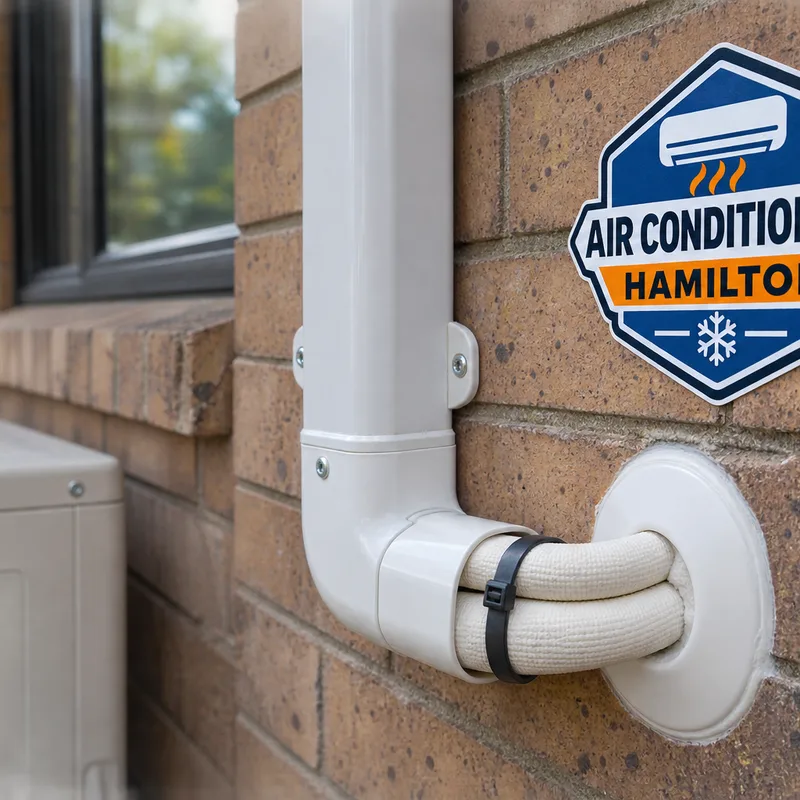
Condensate must discharge to an appropriate point without staining walls, creating slippery areas or draining where it causes a nuisance. Pipe covers should be straight, securely fixed and chosen to give the finished installation a clean appearance.
How Much Does Air Conditioner Installation Cost in Hamilton?
A straightforward single-room split-system supply and installation in Hamilton typically ranges from about NZ$2,500 to NZ$5,000, while multi-room or ducted work can cost considerably more. These are general estimates rather than fixed local prices. Final cost depends on capacity, brand, pipe length, mounting method, access, switchboard or circuit work, drainage and whether wall or ceiling access is difficult. Extras such as pumps, Wi-Fi controls and long exterior covers also affect pricing. The exact cost is confirmed after a site assessment and written installation scope.
Check AvailabilityGet a system recommendation based on the room, the building and the way you use the space, with a clear installation scope before work is scheduled.
Call to ScheduleWhy workmanship matters after the unit is switched on
Installation quality affects noise, drainage, efficiency and service life. Refrigerant pipework must be kept clean and dry during assembly, connections must be made to the manufacturer's requirements, and the circuit must be evacuated with a vacuum pump before commissioning. Simply releasing refrigerant into pipework that still contains air or moisture can lead to poor operation and component damage.
The installer should also check operating temperatures, airflow, drainage and controls. Wall penetrations need weather-resistant sealing, and exposed services need physical protection. For ducted work, return-air sizing, duct layout, insulation and outlet selection all influence comfort. A powerful unit cannot correct restrictive ductwork or poorly positioned outlets.
New Zealand installation work must account for applicable electrical, refrigerant and building requirements. Some situations may also need landlord, body corporate or property-owner approval. If the outdoor unit may be visible from a boundary or shared area, confirm those permissions before committing to its position.
Check AvailabilityAir conditioner installation questions
How long does a split-system installation take in Hamilton?+
A straightforward single split-system installation is often completed within one working day. Long pipe runs, difficult access, concrete or masonry penetrations, condensate pumps and new electrical circuits can extend the work. The expected duration is confirmed once the Hamilton property and proposed unit positions have been assessed.
What size air conditioner do I need?+
The correct size depends on the room's heating and cooling load, not floor area alone. Ceiling height, insulation, glazing, sun exposure and adjoining spaces all matter. Hamilton's seasonal need for both summer cooling and winter heating should also be included when selecting the unit's rated capacity.
Can one high-wall unit cool several rooms?+
One high-wall unit can condition a connected open-plan area, but it rarely gives even temperature control in several closed rooms. Airflow through doorways is limited, particularly when bedroom doors are shut. A multi-split, several separate systems or a properly designed ducted system may provide better room-by-room coverage.
Do I need a new electrical circuit?+
A dedicated circuit may be required depending on the unit, the existing installation and the manufacturer's instructions. The switchboard, available capacity, isolation point and cable route need assessment. Any required electrical work should be identified in the scope rather than treated as an assumption.
Where should the outdoor unit be installed?+
The outdoor unit needs clear airflow, firm support, service access and a position that limits noise and vibration transfer. It should not be boxed into a tight enclosure or placed where hot discharge air immediately recirculates. Boundary proximity, shared areas and condensate management also need consideration at Hamilton properties.
Can an air conditioner be installed in a rental property?+
Yes, but the property owner's written approval should be obtained before permanent equipment or wall penetrations are installed. The proposed indoor and outdoor positions, electrical work and responsibility for future maintenance should be agreed first. Body corporate approval may also apply to units in multi-unit developments.
Can you replace an old unit using the existing pipes?+
Existing pipes can be reused only when their size, condition, route, insulation and cleanliness suit the replacement system and the manufacturer permits it. Old refrigerant type and contamination risk must also be considered. New pipework is often the better choice when compatibility or condition cannot be confirmed.
What should be included in an installation quote?+
A useful quote should identify the unit and capacity, indoor and outdoor positions, included pipe length, drainage method, mounting, electrical work, exterior covers, commissioning and removal of installation waste. Property-specific exclusions should be written clearly so the price can be assessed on the actual scope.
Plan your Hamilton air conditioner installation
Tell Air Conditioning Hamilton which rooms need heating or cooling. We will assess the property, explain suitable options and provide a clear scope for the installation.